
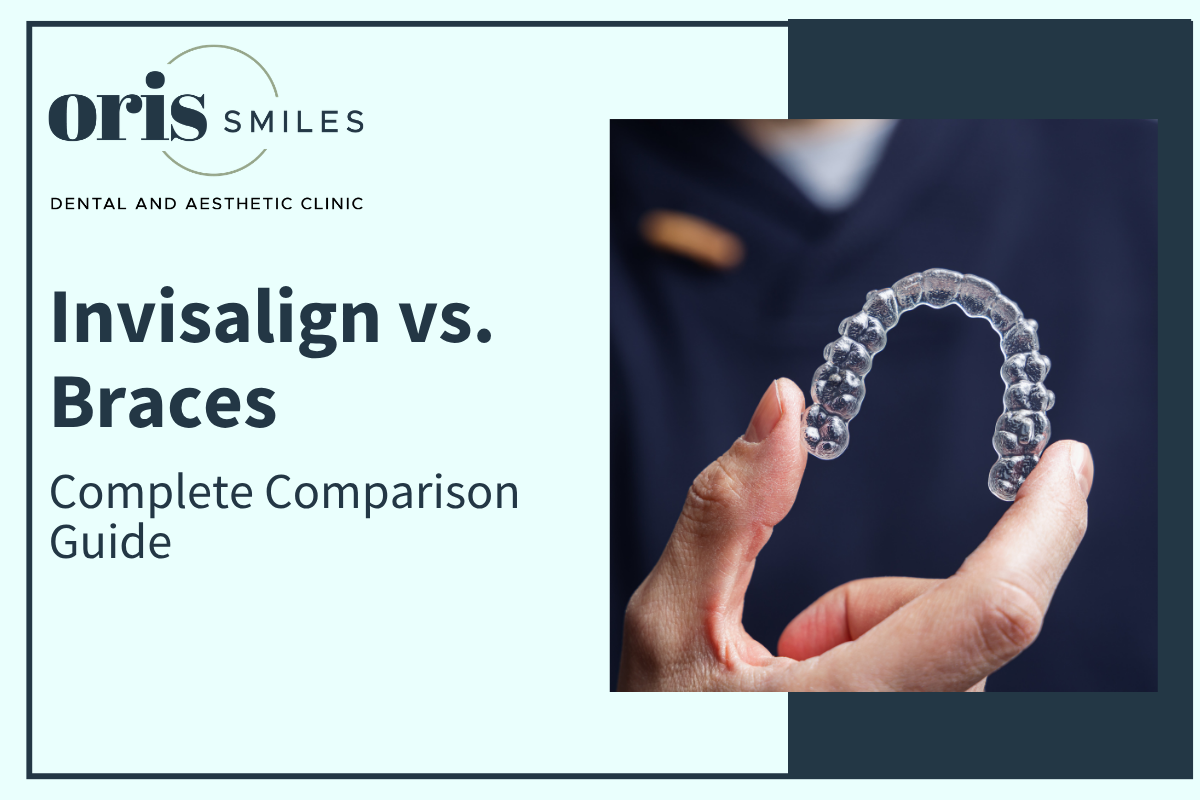
Invisalign vs. Braces in Ahmedabad: Complete Comparison Guide
Teeth straightening requires choosing between two proven orthodontic options: Invisalign clear aligners and traditional braces. Both effectively correct alignment but differ significantly in approach, appearance, comfort, timeline, and cost. Decision depends on alignment severity, lifestyle preferences, timeline, and budget. Dr. Janu Shah at Oris Smiles evaluates individual cases determining optimal treatment. Digital technology enables detailed comparison before treatment commitment. Both options provide predictable results within Ahmedabad dental market. Call 063536 90788 to compare treatment options for your smile.
How They Work: Fundamental Differences
Invisalign uses custom-designed clear plastic aligners made from FDA-approved SmartTrack thermoplastic material. Sequential aligners apply gradual pressure to teeth with replacement every one to two weeks. 3D digital imaging creates precise treatment sequence. Patients control removal enabling flexibility for eating and cleaning. Nearly invisible appearance maintains confidence throughout treatment.
Traditional braces use metal or ceramic brackets bonded to tooth surfaces with archwires threaded through connecting teeth. Regular tightening every four to six weeks creates sustained pressure advancing tooth movement. Provider-controlled fixed treatment delivers consistent twenty-four-seven force application. Highly visible brackets and wires create obvious appearance change. Tightening appointments cause moderate soreness lasting one to two days.
Key differences include force application (intermittent versus continuous), patient control (high removability versus fixed placement), adjustment frequency (less frequent versus regular), treatment visibility (digital design versus clinical adjustments), and complexity capability (simpler cases versus advanced cases).
Comfort and Lifestyle Comparison
Invisalign offers smooth plastic material causing no bracket irritation with custom-molded fit enabling minimal gum discomfort. Removable design provides brief relief during eating and cleaning. Gradual pressure creates mild discomfort only one to two days after new aligner insertion. No mouth ulcers or bracket-related injuries occur. Speech adjustment minimal and temporary.
Traditional braces cause metal bracket irritation initially with wire tightening creating moderate soreness following adjustments. Mouth ulcers possible from bracket-related cuts. Gum tenderness results from constant pressure. Adjustment period typically requires several days post-tightening. Dietary restrictions avoid hard and sticky foods preventing pain and bracket damage. Oral hygiene difficulty around brackets complicates cleaning routines. General discomfort persists one to two days post-adjustment.
Invisalign provides superior baseline comfort and convenience. Braces offer predictable discomfort manageable through pain relief. Individual pain tolerance creates variable experiences among patients. Invisalign enables normal activity continuation while adjusting to aligner presence.
Treatment Timeline and Cost
Invisalign averages twelve to eighteen months with mild cases completing in six to twelve months. Moderate cases require twelve to eighteen months. Complex cases may need eighteen to twenty-four months or braces preferable. Office visits occur every five to six weeks lasting fifteen to twenty minutes. At-home progression occurs patient self-managed through aligner changes.
Traditional braces average eighteen to twenty-four months with mild cases achieving twelve to eighteen months. Moderate cases require eighteen to twenty-four months. Complex cases may extend twenty-four to thirty-six months. Office visits occur every four to six weeks lasting thirty to forty-five minutes. Clinical progression controlled through provider adjustments.
Invisalign advantages include fewer visits and potentially faster completion. Braces offer predictable timelines for complex cases. Busy professionals benefit from Invisalign’s minimal appointment frequency. Both require strict compliance for effectiveness.
Cost comparison shows Invisalign (₹40,000–₹80,000) comparable to traditional braces similarly priced. Mild cases cost less than complex cases. Most insurance plans cover both similarly with thirty to fifty percent orthodontic benefits. Financing options include monthly installments, EMI arrangements, and seasonal promotions. Transparent pricing prevents hidden fees.
Effectiveness and Suitability
Invisalign excels at mild-to-moderate alignment issues including spacing, minor rotations, anterior crowding, and mild bite problems. Not suitable for severe crowding (fifty percent-plus misalignment) or complex skeletal issues.
Traditional braces effectively treat all severity levels from mild to severe. Superior for complex crowding, severe skeletal misalignment, and advanced bite correction. Best option for vertical dimension changes and implant preparation foundations.
Invisalign often faster and less visible for mild-moderate cases. Braces provide greater precision for complex bite correction. Both yield similar final aesthetic results when appropriate cases selected.
Frequently Asked Questions About Invisalign vs. Braces
Which treatment is faster: Invisalign or braces?
Invisalign averages twelve to eighteen months; braces eighteen to twenty-four months. Invisalign often faster for mild-moderate cases. Complex cases may favor braces.
Are Invisalign and braces equally effective?
Both highly effective for appropriate cases. Invisalign excels at mild-moderate issues; braces superior for complex misalignment and bite correction.
Which is more painful: Invisalign or braces?
Invisalign typically less painful with smooth plastic versus metal irritation. Braces cause soreness after adjustments; Invisalign causes mild discomfort with new aligner only.
Does insurance cover both equally?
Most plans cover both similarly with thirty to fifty percent orthodontic benefits. Insurance verification determines actual coverage before treatment.
Can Invisalign fix severe crowding?
Mild-moderate crowding addresses well. Severe crowding may require traditional braces for effectiveness.
Ready to discover your ideal orthodontic solution? Schedule your consultation with Dr. Janu Shah at Oris Smiles Dental Clinic. Call 063536 90788 or visit https://www.orissmiles.com/. Located at 103, Shreeya Atlanta, Sindhubhavan Road, Thaltej, Ahmedabad 380059. Hours: Monday to Saturday, 10 am to 7 pm.
