
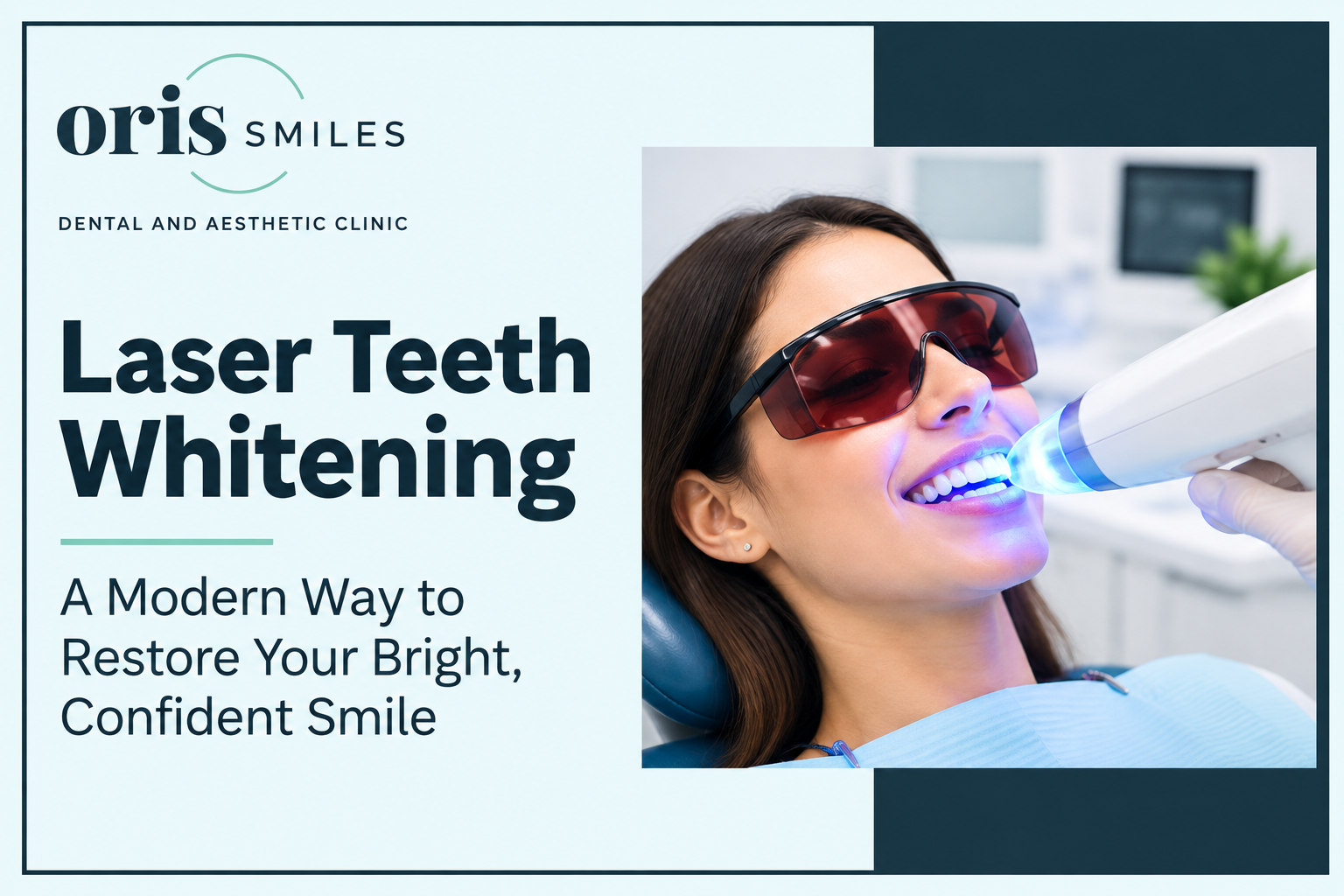
Laser Teeth Whitening: A Modern Way to Restore Your Bright, Confident Smile
A bright smile can change the way you feel about yourself. Yet, even with regular brushing, teeth can gradually lose their natural brightness because of coffee, tea, tobacco, aging, certain medications, or other causes of discoloration. When everyday oral care is no longer enough to improve the shade of your teeth, professional whitening can be a practical cosmetic dental option.
Among the available treatments, Laser Teeth Whitening Treatment is designed for people who want a noticeable improvement in their smile without undergoing an invasive procedure. At Oris Smiles Dental Clinic, teeth whitening is offered as a non-invasive cosmetic treatment using modern technology, with in-office bleaching capable of producing visible results in a single sitting.
What Is Laser Teeth Whitening?
Laser teeth whitening is a professional cosmetic dental procedure in which a dentist applies a whitening gel to the teeth and uses specialized light technology to activate the whitening process. The bleaching agent works on stain molecules, helping reduce discoloration and lighten the natural shade of the teeth.
Unlike whitening toothpaste or over-the-counter products, professional whitening is carried out after evaluating your teeth and gums. This allows the dentist to understand the type and extent of discoloration before recommending the most appropriate approach.
At Oris Smiles, in-office bleaching is one of the available whitening options, alongside whitening toothpaste, whitening gels, and dentist-supervised tray-based whitening. The suitable option depends on the individual’s dental condition and whitening goals.
Why Do Teeth Become Discolored?
Teeth do not always become yellow or darker because of poor brushing. Discoloration can have several causes, and identifying the cause is important when deciding on treatment.
Food and Beverages
Regular consumption of tea, coffee, wine, cola, and other strongly pigmented foods or drinks can gradually leave stains on the tooth surface. These are generally considered external or extrinsic stains.
Tobacco and Smoking
Smoking and tobacco use can cause noticeable tooth discoloration. Tobacco stains may become increasingly difficult to remove over time, particularly when combined with inadequate oral hygiene.
Aging
As we grow older, the outer enamel layer naturally becomes thinner. The underlying dentin has a naturally warmer or yellowish appearance, which can make teeth look darker with age.
Medications and Fluorosis
Certain medications taken during tooth development can contribute to intrinsic staining. Excessive fluoride exposure during development may also result in changes such as white streaks or brownish discoloration.
Because discoloration can have different causes, professional assessment is useful before choosing a whitening procedure.
How Does the Treatment Work?
The process begins with a dental evaluation. Your dentist examines the teeth and discusses your expectations to determine whether professional whitening is appropriate.
Once the teeth are prepared, a professional whitening gel is applied to the tooth surfaces. With laser-assisted whitening, specialized light technology activates the bleaching agent and helps accelerate the whitening process.
The treatment is non-surgical and does not require injections. According to Oris Smiles, in-office bleaching generally takes around 30 to 60 minutes, and the teeth may become several shades lighter during the appointment.
The exact outcome, however, differs from person to person. Your starting tooth shade, type of staining, oral health, and lifestyle habits can all influence the final appearance.
Benefits of Professional Whitening
Choosing a dentist-supervised whitening procedure has several advantages.
Quick improvement: In-office whitening is designed to produce visible changes within a short appointment, making it useful for people looking for a relatively fast smile enhancement.
More uniform results: Professional application allows the whitening treatment to be distributed carefully across the visible teeth, helping create a more consistent appearance.
Non-invasive approach: Teeth whitening does not involve surgery or injections. It is primarily a cosmetic procedure focused on improving tooth color.
Reduced risk of inappropriate use: A dental professional can assess existing sensitivity, gum concerns, restorations, and other factors before treatment.
Customized guidance: Not every type of discoloration responds in the same way. A dentist can help determine whether whitening, veneers, bonding, or another cosmetic solution is more suitable.
Is Laser Whitening Suitable for Everyone?
Professional whitening can be suitable for many adults, but it is not automatically the right solution for every type of discoloration.
Surface stains caused by tea, coffee, smoking, tobacco, and similar habits may respond well to whitening. However, deeper intrinsic discoloration may require a different cosmetic approach. For example, Oris Smiles also provides dental veneers and tooth bonding, which may be considered when discoloration does not respond adequately to whitening.
Existing crowns, veneers, and fillings also do not change color in the same way as natural teeth. Therefore, if visible restorations are present, shade matching should be discussed with your dentist before treatment.
People with gum recession or exposed root surfaces may also experience sensitivity or have areas that are more difficult to whiten. Pregnant and lactating women are advised by Oris Smiles to defer whitening because the potential effects of bleaching agents are not completely understood.
What Should You Do After Whitening?
Your habits after treatment can have a significant impact on how long your brighter smile remains.
For the initial period following treatment, it is sensible to reduce dark-colored foods and beverages that can contribute to new staining. Coffee, tea, wine, tobacco, and strongly pigmented foods should be limited as much as possible.
Good oral hygiene also matters. Brush regularly using the technique recommended by your dentist, floss consistently, and attend routine dental check-ups. If you regularly consume staining beverages, using a straw can reduce direct contact between the drink and your front teeth.
Oris Smiles also recommends avoiding dark-colored foods and beverages for at least ten days after the procedure, limiting tea, coffee, and wine, avoiding tobacco, maintaining proper oral hygiene, and attending regular follow-ups. A maintenance whitening treatment may be recommended when appropriate.
Can Whitening Give You Perfectly White Teeth?
One important point is that whitening does not create an artificial shade that is identical for everyone. Natural tooth color varies, and professional whitening can only lighten the teeth within an appropriate range.
The final result depends on the original shade and the cause of discoloration. In addition, the complete effect of bleaching may continue to become apparent after treatment, which is particularly important if you are planning veneers or another cosmetic dental procedure that requires accurate shade matching.
Therefore, the goal should be a brighter, natural-looking smile rather than an unrealistic shade of white.
Why Choose Oris Smiles for Your Whitening Journey?
At Oris Smiles Dental Clinic, teeth whitening is approached as part of personalized cosmetic dental care rather than a one-size-fits-all procedure. The clinic offers different whitening options and evaluates the condition and degree of staining before helping patients select an appropriate treatment.
Led by Dr. Janu Shah, the clinic focuses on cosmetic dentistry and modern dental technology, with an emphasis on tailoring treatment to individual needs.
If you are considering professional whitening in Ahmedabad, a consultation can help you understand the likely outcome, possible sensitivity, and whether Laser Teeth Whitening Treatment is suitable for your teeth.
Give Your Smile a Brighter Start
A dull or stained smile does not necessarily mean you need extensive cosmetic dentistry. In many cases, professional whitening can provide a simple, non-invasive way to refresh the appearance of natural teeth.
The best first step is to understand why your teeth have changed color and choose a treatment based on that cause. With professional guidance, appropriate aftercare, and healthy oral hygiene habits, you can work toward a brighter smile while keeping your expectations realistic.
If you’re ready to explore Laser Teeth Whitening Treatment, schedule a consultation with Oris Smiles Dental Clinic to discuss your smile goals and discover which whitening approach may be right for you.
FAQs
1. What is Laser Teeth Whitening Treatment?
Laser Teeth Whitening Treatment is a professional cosmetic dental procedure that uses whitening gel along with specialized light technology to help reduce tooth discoloration and brighten the natural shade of your teeth.
2. How long does laser teeth whitening take?
An in-office whitening session generally takes around 30 to 60 minutes. The exact treatment time may vary depending on the level of discoloration and the whitening approach recommended by your dentist.
3. Is Laser Teeth Whitening Treatment safe?
When performed under professional dental supervision, teeth whitening is a non-invasive cosmetic treatment. Your dentist can assess your teeth and gums beforehand and provide guidance to help minimize potential sensitivity or irritation.
4. How long do teeth whitening results last?
The longevity of whitening results varies from person to person. Maintaining good oral hygiene, limiting staining foods and beverages such as coffee and tea, avoiding tobacco, and following your dentist’s aftercare recommendations can help maintain a brighter smile.
5. Is everyone a suitable candidate for teeth whitening?
Not necessarily. Whitening works differently depending on the cause of discoloration. Intrinsic stains, existing dental restorations, gum concerns, or certain situations may require an alternative cosmetic treatment. A dental consultation can help determine whether professional whitening is appropriate for you.
